
India's services sector growth recorded another month of robust expansion in July, albeit at a slightly slower pace than in June, largely supported by robust demand conditions and investment in technology, a monthly survey said on Monday. The seasonally adjusted HSBC India Services Business Activity Index was at 60.3 in July, down only fractionally from 60.5 in June. In the Purchasing Managers' Index (PMI) parlance, a print above 50 means expansion, while a score below 50 denotes contraction.

PMI increased from 52.0 in August to 56.8 in September -- highest since January 2012.


New business received by Indian manufacturers expanded at the fastest pace since February.

Institutional investments in Indian real estate have seen a strong start to 2025, with inflows reaching $ 1.3 billion in the first quarter - a 31 per cent year-on-year (YoY) increase. This growth was primarily driven by domestic investments, which accounted for 60 per cent of the total inflows during the quarter. With $ 0.8 billion inflows, domestic investments saw a 75 per cent annual rise and were largely focused on industrial & warehousing and office segments.

India's services sector growth quickened in June from May's five-month low, amid a stronger rise in new orders and an unprecedented expansion in international sales, a monthly survey said on Wednesday. The seasonally adjusted HSBC India Services Business Activity Index rose from 60.2 in May to 60.5 in June, pointing to a sharp expansion in output. In the Purchasing Managers' Index (PMI) parlance, a print above 50 means expansion, while a score below 50 denotes contraction.
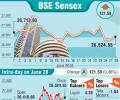
The S&P BSE Sensex gained 122 points to end at 26,525.

The services sector growth in India moderated in February amid softer expansions in business activity, sales and jobs, a monthly survey said on Tuesday. The seasonally adjusted HSBC India Services Business Activity Index registered 60.6 in February, down from 61.8 in January. In Purchasing Managers' Index (PMI) parlance, a print above 50 means expansion, while a score below 50 denotes contraction.

The growth was primarily driven by domestic investments, which accounted for 60 per cent of the total inflows during the first quarter of the financial year.

From the Sensex basket, Power Grid, Asian Paints, Tata Motors, Tata Steel, NTPC, Sun Pharma, Mahindra & Mahindra, HDFC Bank, Tata Consultancy Services and JSW Steel were among the major gainers. Kotak Mahindra Bank, Bharti Airtel, Axis Bank, Wipro, ICICI Bank and IndusInd Bank were among the laggards.

The Nikkei India Manufacturing Purchasing Managers' Index (PMI) stood at 47.9 in July, down from 50.9 in June, its lowest mark since February 2009, and highlighted the first deterioration in business conditions in 2017 so far.

"Any lingering concern that India's manufacturing recovery was tailing off should be put off. A second consecutive rise in PMI has taken the series to a new cycle high consistent on double digit rise in industrial production," said Robert Prior Wandesforde, senior asian economist, HSBC.

India's services sector activity growth touched a five-month high in August on stronger rise in new work orders, while payroll numbers rose solidly as companies remained upbeat regarding the economic outlook, a monthly survey said on Wednesday. The seasonally adjusted HSBC India Services Business Activity Index rose from 60.3 in July to 60.9 in August, registering the fastest expansion since March and was largely supported by productivity gains and positive demand trends.

The implication of April 2 reciprocal tariffs on global trade, trends in overseas markets and trading activity of foreign investors would dictate equity investors' sentiment in a holiday-shortened week ahead, according to analysts. Stock markets would remain closed on Monday for Eid-Ul-Fitr.

The mismatch between PMI and core sector could also be due to the fact that while core sector is calculated year-on-year, PMI is calculated month-on-month.

India's manufacturing sector activities lost further growth momentum and fell to a seven-month low in March as demand was constrained by the escalation of the COVID-19 pandemic, a monthly survey said on Monday. The seasonally adjusted IHS Markit India Manufacturing Purchasing Managers' Index (PMI) fell from 57.5 in February to a seven-month low of 55.4 in March. However, the latest reading was indicative of a substantial improvement in the health of the sector that outpaced the long-run series average, it said. In PMI parlance, a print above 50 means expansion while a score below 50 denotes contraction.
Domestic macroeconomic data announcements, global trends, quarterly earnings and foreign fund trading activity would dictate terms in the equity markets this week, analysts said. Besides, movement of rupee against the US dollar and global oil benchmark Brent crude price would also guide the trading pattern in the equity markets. "From a macroeconomic perspective, market participants will be closely observing key events like the upcoming release of the US manufacturing PMI data, US services PMI data and US non-farm payrolls scheduled between August 1 and August 4.

The services sector growth in India rose to a three-month high in December supported by favourable economic conditions and positive demand trends, a monthly survey said on Friday. The seasonally adjusted HSBC India Services PMI Business Activity Index rose from 56.9 in November to 59 in December, highlighting a sharp increase in output that was the most pronounced since September. In Purchasing Managers' Index (PMI) parlance, a print above 50 means expansion while a score below 50 denotes contraction.

India's manufacturing sector activities witnessed the strongest rate of growth in three months in July amid improved demand conditions and easing of some local COVID-19 restrictions, a monthly survey said on Monday. The seasonally adjusted IHS Markit India Manufacturing Purchasing Managers' Index (PMI) rose from 48.1 in June to 55.3 in July, pointing to the strongest rate of growth in three months. In PMI parlance, a print above 50 means expansion while a score below 50 denotes contraction.

India's services sector witnessed one of the strongest growth rates in over 13-and-a-half years in March on the back of strong demand that spurred sales and business activity, a monthly survey said on Thursday. The seasonally adjusted HSBC India Services Business Activity Index rose from 60.6 in February to 61.2 in March, one of the strongest expansions in total sales and business activity in close to 14 years. In the Purchasing Managers' Index (PMI) parlance, a print above 50 means expansion, while a score below 50 denotes contraction.

India's manufacturing sector activities eased slightly in February but firms were upbeat as they responded to increased new work intakes by stepping up production and purchasing activities, a monthly survey said on Monday. The seasonally-adjusted IHS Markit India Manufacturing Purchasing Managers' Index (PMI) fell marginally to 57.5 in February from 57.7 in January, indicating that even though the pace of growth eased from January it remained sharp in the context of historical data. The headline figure for February remained above its long-run average of 53.6, the survey noted. In PMI parlance, a print above 50 means expansion while a score below 50 denotes contraction.

India's manufacturing expanded at a faster pace than China

In the Sensex pack, HCLTech rose the maximum by 3.12 per cent, followed by ITC which gained 2.73 per cent and M&M went up 2.61 per cent. TCS climbed 2.44 per cent. Tech Mahindra, Wipro, L&T and Maruti were among the other major gainers.

India's manufacturing sector growth slowed marginally in February, although strong domestic orders were likely to support output expansion in the coming months, an HSBC survey has said.

If growth reverts to the pre-Covid level, a lot of people may have to temper their rosy optimism, points out Debashis Basu.
While manufacturing firms cut jobs for the first time in 20 months to sharply reduce costs, services providers continued their hiring spree.

RBI's interest rate decision, macroeconomic data and global trends would dictate terms in the equity market in a holiday-shortened week, analysts said. Besides, the focus will also be on foreign portfolio investors' trading activity, they added. Equity markets will remain closed on Tuesday for 'Mahavir Jayanti' and on Friday on account of 'Good Friday'.
On the other hand, jobs increased for the 10th straight month in the manufacturing sector, albeit only slightly
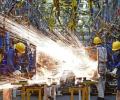
The headline seasonally adjusted IHS Markit India Manufacturing Purchasing Managers' Index (PMI) fell to 27.4 in April, from 51.8 in March, reflecting the sharpest deterioration in business conditions across the sector since data collection began over 15 years ago. The index slipped into contraction mode, after remaining in the growth territory for 32 consecutive months. In PMI parlance, a print above 50 means expansion, while a score below that denotes contraction.

Input shortages and low inventories, according to Nomura, will likely lead to production cuts and delayed shipments in the September 2021 quarter.

The Nikkei Markit India Manufacturing Purchasing Managers' Index (PMI) -- an indicator of manufacturing activity -- fell to 49.6, down from 52.3 in November, coming below the crucial 50 threshold which separates contraction from expansion.
The PMI has risen sharply from 52.9 in July, the lowest reading in the 29-month history of the survey.

From the Sensex pack, State Bank of India, Axis Bank, IndusInd Bank, Tech Mahindra, HCL Technologies, Tata Consultancy Services, Maruti Suzuki, Tata Steel and Tata Motors were the major gainers. Power Grid and HDFC Bank were the laggards from the pack.

The Nikkei Markit India Manufacturing Purchasing Managers' Index (PMI) -- an indicator of manufacturing activity -- declined from 52.5 in April to a three-month low of 51.6 in May.

Reflecting a loss of "growth momentum", manufacturing activities in the country slowed down to a six-month low in March amid softer increases in new orders, production and employment, according to a survey.

The services sector growth in India fell to a one-year low in November on softer expansions in new work intakes and output, despite receding price pressures, a monthly survey said on Tuesday. The seasonally adjusted S&P Global India Services Business Activity Index fell from 58.4 in October to a one-year low of 56.9 in November. Despite witnessing a month-on-month decline, the rate of expansion was stronger than its long-run average.

From the Sensex basket, Kotak Mahindra Bank, HCL Technologies, ICICI Bank, Infosys, Tata Consultancy Services, Wipro, Tech Mahindra and Larsen & Toubro were the major laggards. Mahindra & Mahindra, Nestle, Tata Motors and IndusInd Bank were among the gainers.
India's services sector growth eased slightly in April but growth of new business and output remained sharp and among the fastest in 14 years amid favourable economic conditions and strong demand, a monthly survey said on Monday. The seasonally adjusted HSBC India Services Business Activity Index fell from 61.2 in March to 60.8 in April, highlighting one of the strongest growth rates seen in just under 14 years. Survey members attributed the latest upturn in output to favourable economic conditions, demand strength and rising intakes of new work.

Macroeconomic data announcement, Omicron situation and global trends will be the major driving factors for the equity market in the first week of the new year 2022, according to analysts. In what turned out to be a historic year, the Indian stock indices went past multiple milestones and the 30-share Sensex made an annual gain of 10,502.49 points or 21.99 per cent in 2021. Religare Broking Vice-President (Research) Ajit Mishra said, "This week marks the beginning of a new month and participants will be closely eyeing some crucial high-frequency data like monthly auto sales, India manufacturing PMI and India services PMI. "Besides, updates on the COVID-19 situation and performance of global markets will also be critical."

The Nikkei Markit India Manufacturing Purchasing Managers' Index increased to 50.7 in February
